
You need a visual direction for your project. So you search for concept art services. Then the results confuse you.
Almost every provider is built for AAA video games. They quote per-asset prices for a hundred characters. They speak in pipelines, art directors, and production handoffs. But you run a brand, write books, or lead a small studio. That world does not fit your project.
This guide fixes that gap. First, we explain what concept art services include, in plain terms. Then we cover how pricing really works, so you can budget without guesswork. You also get a clear freelancer-versus-studio comparison, so you can hire well. Finally, we walk through the deliverables and the process, start to finish.
At Raysome Studio, we treat concept art as world-building, not just a game-industry line item. We use it to shape brand worlds, book covers, and campaign visuals. So this guide speaks to your project, not a 200-person game team. By the end, you will know what to ask for, what to expect, and roughly what to budget.
Quick Answer: What Do Concept Art Services Include?
Concept art services are early visual studies. They define how an idea should look and feel before production begins. A studio explores mood, characters, environments, and color while the idea is still easy to change.
You get sketches, mood boards, and style frames, not finished ads or packaging. The goal is a clear direction, not a polished end product. Brands, authors, and studios all use it to lock their vision first. Pricing is wide and depends on scope. Public guides point to broad starting ranges, which we break down below. The rest of this guide fills in the detail.
What Concept Art Services Actually Include
Concept art is a working tool, not gallery art. Its job is to solve visual problems early. The practice is old and well established. In fact, the U.S. Bureau of Labor Statistics groups this work with fine artists and illustrators. Their whole role is turning ideas into images.
So what do you actually receive? The deliverables depend on your project. But most engagements include some mix of the items below.
- Mood boards and references. These set the emotional tone and visual language early.
- Silhouette and shape studies. Simple black-and-white forms test character and object personality fast.
- Character sheets. These show poses, expressions, and details for a figure or mascot.
- Environment studies. These explore the world, setting, or space a brand or story lives in.
- Color and lighting direction. A palette guides how every later asset should feel.
- Style frames. These are polished sample scenes that preview the final look.
Each piece helps you make a decision. That is the real point of the work. Rough sketches often matter as much as finished ones, because they let you compare directions cheaply. Most studios move from brief to references, then to thumbnails, refinement, and final art. So you commit real money to production only after the direction is clear.
Who Needs Concept Art Services
Concept art is famous in games and film. Even so, it helps far more people than that. Any project that needs a strong, consistent visual world can use it. Below are the three groups we work with most.
Brands
A brand can have a clean logo and still feel empty. That happens when the pieces do not share one idea. Concept art solves this by building a world first.
Picture a skincare brand exploring translucent surfaces and warm light. Or a coffee brand built around the quiet before a busy day. That direction then guides packaging, the website, and campaigns. So concept art and brand identity work best as a pair. One gives structure; the other gives atmosphere.
Authors and Publishers
Books live or die on their visual world. A cover must signal genre, mood, and quality in one glance. Concept art helps you find that look before final art begins.
An author might test three cover directions before choosing one. A series might define its hero early, then build the world around that character. This is where concept art feeds directly into book cover design and character design services. As a result, the finished book feels intentional, not assembled.
Studios and IP Projects
Games, animation, and entertainment projects need visual worlds by default. Concept art defines characters, environments, props, and mood before production. Consequently, teams avoid expensive changes to finished 3D models later.
Smaller studios gain the most from this discipline. A clear concept package keeps a whole team aligned. Instead of ten people picturing ten different worlds, everyone builds the same one.
How Much Do Concept Art Services Cost?
Let’s talk money directly, with one honest caveat first. There is no universal price sheet for this work. Public guides suggest broad starting ranges. But real quotes vary a lot by scope, rights, and refinement. So treat every number below as an indicative starting point, not a fixed rate.
With that said, the public ranges do cluster. Several 2025–2026 guides agree on the shape. Simple sketches sit in the low hundreds; polished pieces reach four figures. One widely cited concept art pricing guide lists roughly $50 to $1,500 or more per piece. Experience, detail, and usage rights drive that spread. A separate studio price list points to a similar shape: sketches near the bottom, detailed work near the top.
The table below gathers those public ranges into rough tiers. Read them as indicative, in USD.
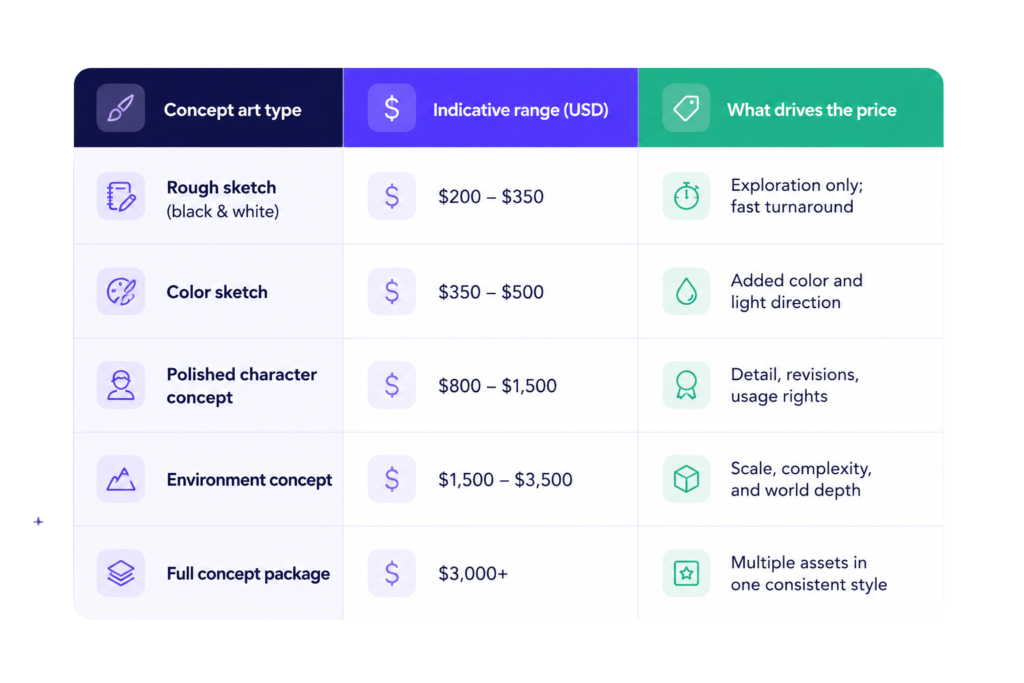
These tiers echo figures from several independent guides, including a studio pricing handbook. Your own quote depends on scope. In practice, four things move it most: complexity, number of concepts, revision rounds, and usage rights. Commercial rights especially raise the price. So if you plan to use the art in marketing, flag that early and budget for it.
Freelancer vs. Studio: How to Choose
This is the decision most buyers get stuck on. Both options work, but they serve different needs. The right choice depends on your scope, timeline, and internal resources.
A freelancer usually costs less per hour. Public comparisons put mid-to-senior freelance rates around $25 to $120 per hour. Blended studio rates tend to sit higher. So for one or two pieces, a freelancer often wins on price. In return, you manage the brief, the revisions, and the quality checks yourself.
A studio changes that math as scope grows. For a large, multi-asset project, a studio often costs less overall once you count coordination and rework. You also get consistency across artists, structured reviews, and reliable timelines. Therefore, studios tend to fit brand worlds, book series, and full campaigns better.
The table below sums up the tradeoffs.
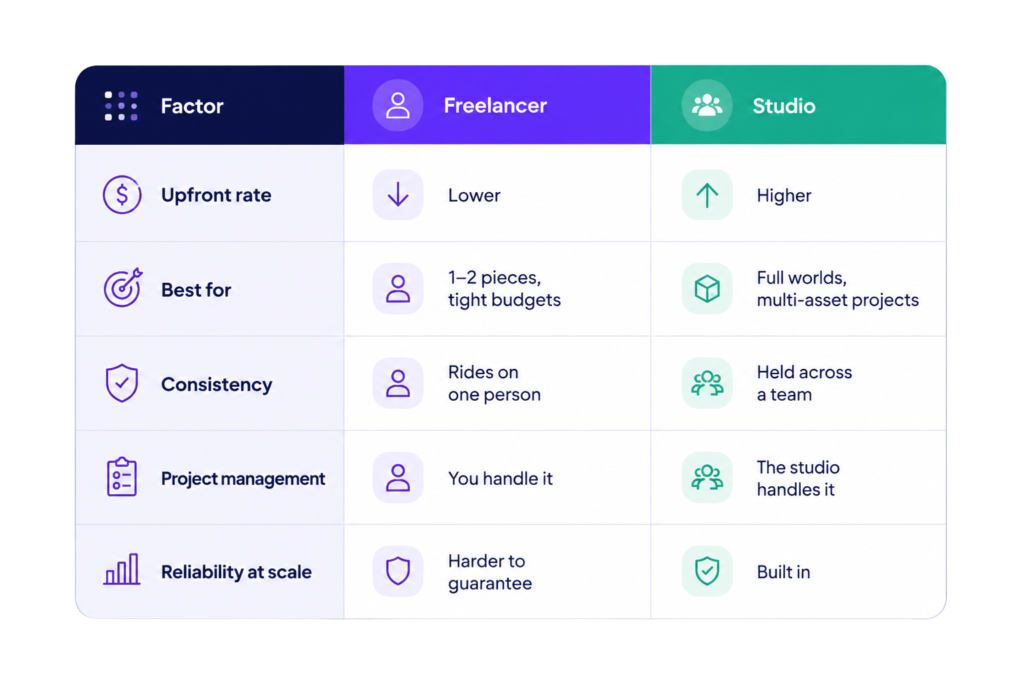
Neither option is right for everyone. A single character sketch is a clear freelancer job. A full brand world, with characters, environments, and campaign frames, is studio work. So match the model to the size of your vision.
What a Concept Art Engagement Looks Like at Raysome
At Raysome, we run every concept project through a clear process. It removes the guesswork and keeps you in control. Here is how it actually works.
1. Discovery. First, we learn your brand, audience, goals, and references. This defines what the work must communicate, not just how it looks.
2. Visual research. Next, we gather references around shape, color, light, and mood. This maps possible directions rather than copying existing work.
3. Direction exploration. Then we develop a few early routes. These may be rough sketches, thumbnails, or color studies. The point is to compare clearly different ideas.
4. Review. After that, you review the directions and give focused feedback. Together, we pick one route or blend the strongest parts of a few.
5. Refinement. Now we sharpen the chosen concept. Characters, environments, and color relationships become specific and clear.
6. Concept package. Finally, we deliver the approved work. That can include style frames, character sheets, environment studies, and color direction.
This mirrors how professional engagements usually run. Common practice is a deposit upfront with staged delivery. Clear written terms then cover rights, source files, and revisions. Timelines scale with the number of directions and the depth of the world. You can see our work to get a feel for the range. Some projects end at the concept stage; others carry on into full production.
Frequently Asked Questions
How much do concept art services cost per piece?
Public guides suggest single pieces often start in the low hundreds and climb into the four figures. Simple sketches sit near the bottom of that range. Polished, detailed concepts sit near the top. Complexity, revisions, and usage rights move the final price, so treat any figure as a starting point.
Do I own the concept art once it’s finished?
Ownership depends entirely on your written agreement, so read it closely. Note one common myth. A “work made for hire” clause does not automatically transfer copyright for commissioned art. Per the U.S. Copyright Office, a commissioned work counts as work-for-hire only if it fits nine narrow categories. General artwork usually does not. So most studios transfer rights through a copyright assignment instead. Your contract should state what rights pass to you. It should also cover source files and any portfolio rights the studio keeps. This is general information, not legal advice.
What’s the difference between concept art and illustration?
Concept art explores ideas for production; illustration is a finished, standalone piece. Concept work moves fast and tests many options. An illustration is polished and meant to stand on its own. In short, one solves problems, and the other presents a final image.
How long does a concept art project take?
It depends on scope, but most brand projects run a few weeks. A single piece can take days. A full package with many assets takes longer. More directions and more refinement both add time.
Can concept art be used for marketing later?
Yes, and many brands do exactly that. Concept work is often reworked into ads and promotional material once approved. However, commercial use can affect your cost and rights. So flag any marketing plans during discovery.
Do I need concept art if I only want a logo?
Not always — a simple logo may not need it. But if you want a full brand world, concept art helps a lot. It sets the mood and style that guide every later asset. A single mark, though, can often skip this stage.
Freelancer or studio, which is cheaper?
For one or two pieces, a freelancer is usually cheaper. For large, multi-asset projects, a studio often costs less overall. Studios reduce revision cycles and hold quality steady across artists. So the cheaper option depends entirely on your scope.
Conclusion
Concept art services give your project a visual world before you commit to production. That saves money, prevents chaos, and makes the final work feel connected.
Remember three things. First, you are paying for direction, not a finished product. Second, prices vary widely, so treat public ranges as starting points and get a scoped quote. Third, freelancers suit small jobs, while studios suit full worlds. Match the choice to the size of your vision, and the work will hold up.
Build Your Brand World With Raysome Studio
Need concept art that turns your idea into a world people remember? We create concept art, character design, and brand visuals for brands, authors, and studios. Let’s define your visual direction before you spend a dollar on production.